Workplace Systems / July 23, 2026
Clock Cards, Badge Racks and the Workplace Record
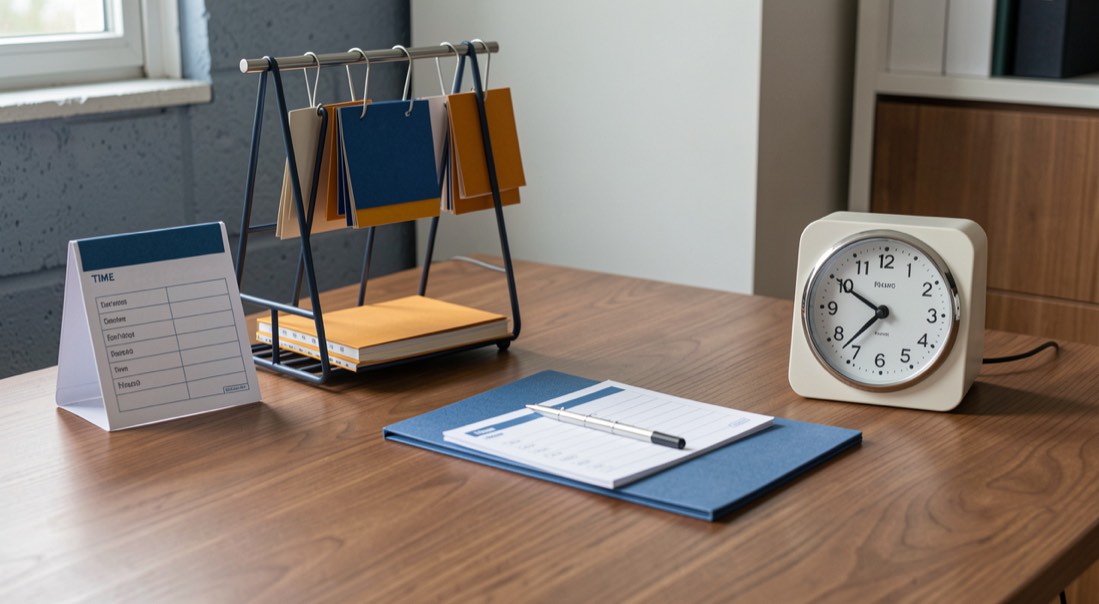
A card, badge rack or attendance board is a visible interface to a record system.
01
Visibility can be a feature
A physical card system makes a state legible at a glance, but it also creates handling, storage and reconciliation work. A digital system hides the physical board and introduces different questions about access and auditability.
The decision is about the workplace routine, not nostalgia for a device.
02
Document the handoff
Name who issues, corrects, reviews and stores the record. If the workflow has no clear owner, a more sophisticated device will not solve the underlying gap.
03
Treat the object as an interface
A clock card, badge rack or attendance board is a visible interface to a record system. It tells a person what has been issued, returned, placed or left unresolved. That visibility can make a routine easy to understand, but it also exposes the physical work of sorting, correcting, storing and reconciling the record.
Begin by mapping the routine around the object. Who receives a card, where does a badge go when someone leaves, who notices a missing item and how is a correction recorded? The answer matters more than whether the hardware looks old or modern.
04
Compare visibility and auditability
A physical board can support a quick glance and a local fallback, while a digital status view can offer search, permissions and remote reporting. The board may expose names or states to people who do not need them; the digital system may hide a problem behind a login or fail during an outage. Both require an owner and a clear exception route.
Compare the cost of ordinary handling and the cost of an error. If a supervisor can resolve a missing card in seconds, physical visibility may be valuable. If several sites need one report, a connected record may justify its controls. A hybrid needs an explicit reconciliation rule, or two versions of the truth will develop.
05
Test the daily routine
Observe a start-of-shift and end-of-shift cycle with a blank card, a returned badge, a correction and a missing item. Note where the person stands, how long the handoff takes, what gets written, who checks it and where the item is stored. Then repeat with the expected peak traffic, not only a quiet demonstration.
For a workshop with a shared tool room, the rack may need a colour or number system that is legible at a distance and backed by a correction log. For a distributed team, the physical rack may be a local cue while a connected record owns the report. The object only works when the surrounding routine is designed.
06
Correct the common failures
Typical failures include unlabeled slots, an owner who is absent, cards that cannot be matched to the current roster, a badge left in a drawer, and a correction made in pencil with no audit trail. A new rack does not solve an unclear issuing policy. A new app does not solve a team that cannot agree which event needs recording.
Review the routine at a regular interval and keep the physical and digital vocabulary aligned. If an item is retired, mark it. If a record is corrected, state who approved the change. Small labels and clear ownership often create more reliability than a more elaborate interface.
07
Respect workplace limits
This note does not set employment, privacy, access-control or retention policy. Those obligations differ by location and organisation and need current responsible advice. It offers a design lens for visibility, handling and accountability, while the workplace decides which data may be shown and how the record is protected.
The source trail is the historical Cristel URL inventory and the Printroom's practical workplace synthesis. The historical address is preserved as an editorial route; it should not be read as an endorsement of an old device or as a substitute for a current procurement specification.
Source trail
Historical Cristel URL inventory; editorial guidance. Read the editorial method for the difference between a standard, an archive observation and practical synthesis.