Printing & Design / July 17, 2026
General Commercial Printing
The old general-printing address now opens onto the decisions shared by many commercial jobs.
01
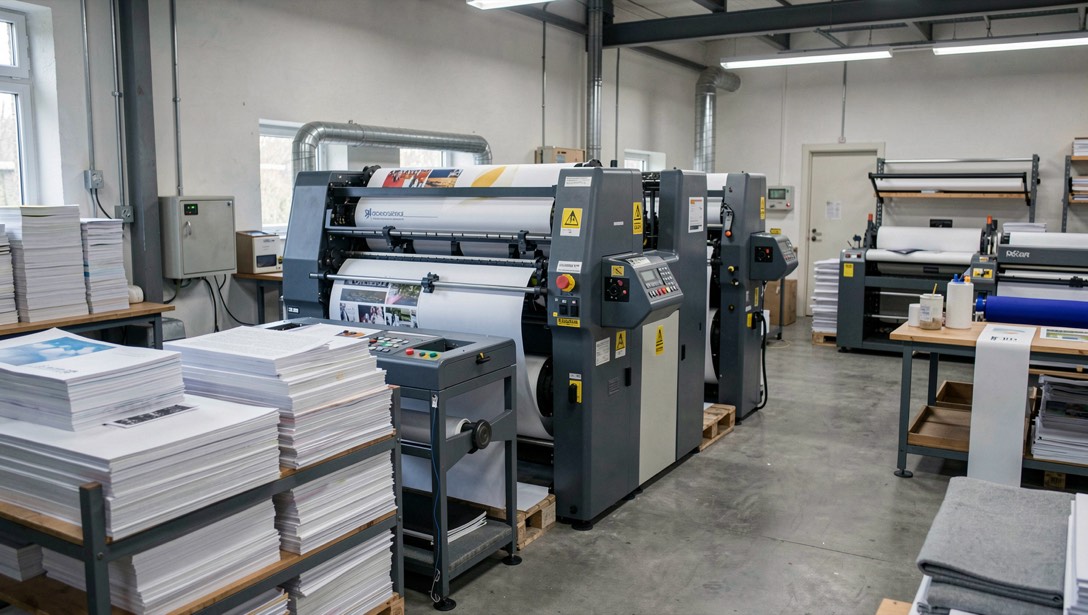
A broad room with technical doors
General printing is not one process. The useful questions are run, versioning, substrate, colour and finish.
02
Continue with the process map
The printing-processes guide keeps those choices connected.
03
Give general printing a real scope
General commercial printing is a family of jobs, not a process name. It can include stationery, brochures, catalogues, forms, inserts, posters and short-run campaign pieces, each with its own route through substrate, imaging, colour and finishing. Use the historical address as an entry point, then write the object and its handling conditions before requesting a price.
The simplest useful brief names the finished size, quantity, versions, paper family, colour expectation, fold or bind, packing and delivery. If one field is still open, state who decides it and what sample will settle the question.
04
Compare digital and offset within the room
Digital can make short runs, late changes and versioned work easier to control, while offset may suit a stable long run that benefits from a repeatable press condition. A general printer may coordinate both, but the choice still depends on substrate, coverage, finish, setup, waste, proof and reprint. The word general does not remove those technical questions.
For a 500-copy event pack with four languages, the workflow and version risk may outweigh an offset unit-price advantage. For a 20,000-copy annual brochure with one approved version, a planned offset run may become attractive. Use the actual job to compare, not a default rule.
05
Test the material and finish
Request a physical sample on the intended stock, with the proposed fold, coating, trim and any code or handwriting area. Review the sheet under ordinary light, check opacity and stiffness, and ask the finishing operator whether the edge or fold needs a different allowance. A clean screen proof does not show how the object will feel or travel.
Record the approved stock reference and the acceptable alternative. That makes a later substitution visible and gives the printer a chance to retest colour, folding and packing rather than silently changing the result to meet a date.
06
Find the generic-job failures
Broad jobs often fail through omitted details: the wrong page order, an unapproved paper substitution, missing bleed, a coating that blocks writing, or a delivery split that was assumed rather than written. Another risk is a quote that separates print and finishing so completely that no one owns the final inspection.
Ask who checks the packed object and how a damaged or incorrect batch is isolated. A simple release sample, count and sign-off can prevent a general order from becoming a collection of plausible but incompatible components.
07
Keep the page honest
The historical path does not certify a current service, supplier, price or material availability. Use this guide to frame a production conversation, then confirm current capability, standards, postal or installation rules and the appropriate acceptance test with the operator responsible for the job.
The source trail combines the Wayback URL inventory, the Printroom Process Library and ISO/TC 130 production guidance. The historical address remains exact; the visible language stays focused on current questions a B2B buyer can verify.
08
Close with a release sample
Before a general order is released, keep one assembled sample that shows the approved stock, fold, finish, trim and packing condition. Mark the file version and delivery destination, then ask a second person to compare the sample with the brief. This small release ritual catches a wrong component or unrecorded substitution after the quote has become a real stack of work.
If the job is repeated, store the sample reference with the production notes and reopen it when paper, equipment or finishing changes. A general category stays useful when every repeat still has a visible object to compare.
Source trail
Wayback URL inventory. Read the editorial method for the difference between a standard, an archive observation and practical synthesis.